Tower Rush – Strategies, Bonuses and Complete Crash Game Guide
Tower Rush isn't the kind of game where you bet and pray. The mechanics demand constant decisions: when to place the block, when to cash out, when to accept the risk of an additional floor. Galaxsys has created a crash game where how you play genuinely influences the outcome of each session.
No approach guarantees profits. Chance remains present, the casino edge too. But bet management, cashout timing, and bonus exploitation concretely modify bankroll lifespan and experience quality. Let's break it all down.
Play with BonusKey Features
| Parameter | Info |
|---|---|
| Game Type | Timing crash game (construction) |
| Player Control | Manual cashout anytime |
| Integrated Bonuses | Frozen Floor, Temple Floor, Triple Build |
| RTP | 96.12–97% |
| Volatility | High |
⭐ Editorial Rating: 4.2 / 5 — Rare strategic mechanics in the crash segment, well-integrated bonuses, but mentally demanding.
Three Bonuses, Three Different Dynamics
Tower Rush bonuses aren't cosmetic. Each one concretely modifies the risk/reward calculation during play. They appear randomly, once per session. When one drops, the situation changes.
Frozen Floor: The Safety Net
When this special floor appears, the current multiplier is frozen as a guaranteed floor. The tower can collapse afterward, winnings remain locked at the Frozen Floor level.
The strategic interest is considerable. After activation, the zero-win scenario disappears. You can risk more, aim for higher floors, attempt an ambitious multiplier knowing the floor is secured. You move from a binary choice (all or nothing) to a choice between guaranteed win and potentially higher win.
Experienced players consider it the game's most valuable bonus. It transforms the very structure of the decision.
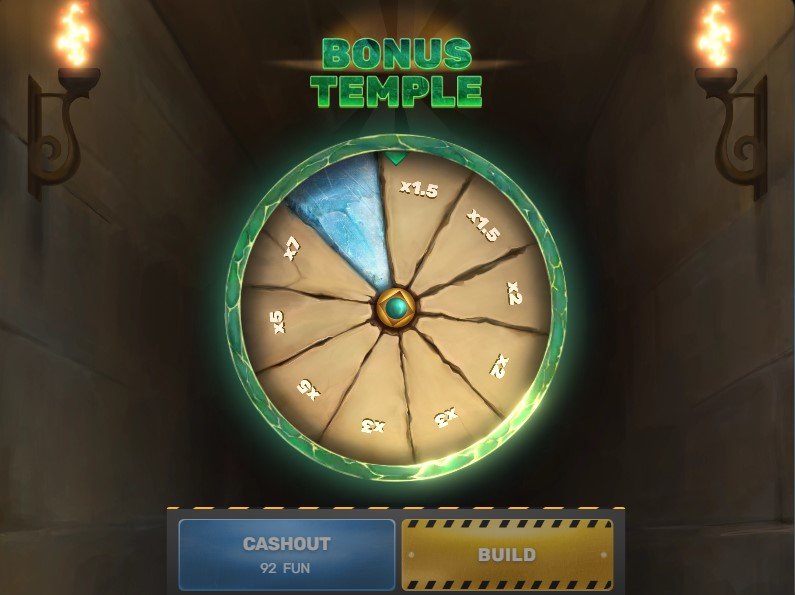
Temple Floor: The Luck Factor
A temple floor triggers a wheel with multiple segments offering variable multipliers. The result is purely random. Sometimes a small boost, sometimes a big bonus. You don't choose, you accept what the wheel gives.
This bonus works better as a complement than as a central strategy element. The classic mistake would be continuing to play solely hoping to trigger a Temple Floor. Its frequency doesn't justify that wait.
Triple Build: Guaranteed Progression
Three floors placed automatically, without player intervention. The multiplier rises three levels at once, without the slightest risk of falling. The only moment in the game where you progress by watching, doing nothing.
Its value is probably the highest of the three in terms of guaranteed win. No chance, no wheel, just three gifted floors that drive the multiplier. And after these three floors, you resume control with a net advantage.
Player Profiles and Management Approaches
Talking strategy on a random game requires nuance. Nobody predicts when the tower collapses. On the other hand, bankroll management and risk behavior are variables the player controls entirely.
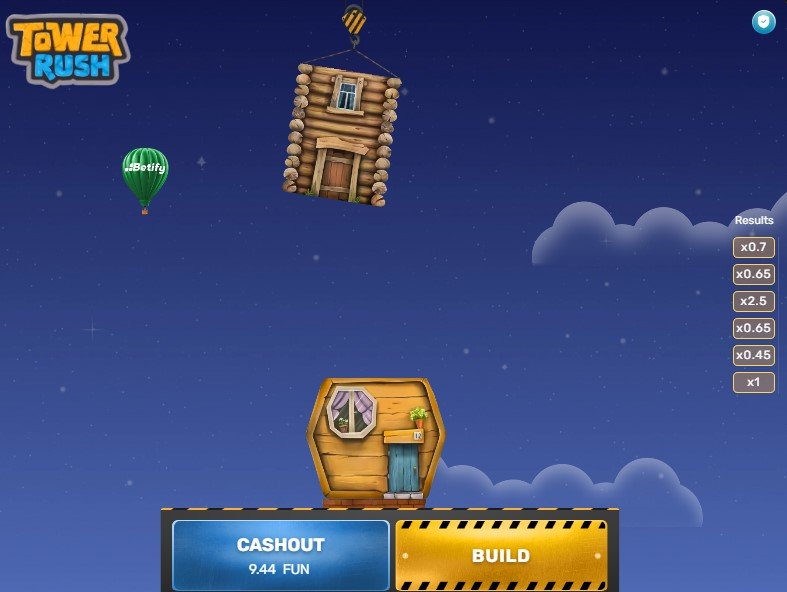
Bankroll Management Is the Real Strategy
Before even talking about cashout, the first decision concerns bet size relative to available capital. Betting 10% of bankroll per round is exposing yourself to depletion in ten unfortunate rounds. At 2-3%, you can absorb 30-40 consecutive failures without disappearing. The difference between both approaches is game lifespan.
Concretely, with a $50 bankroll: bet between $0.50 and $1.50 per round. With $100: between $1 and $3. These figures aren't arbitrary, they aim to maintain at least 30-50 available game rounds. Less than that, variance can take everything in a few unfavorable rounds.
A frequent trap: adapting the bet to the previous result. Winning a good multiplier and doubling the next bet, or tripling it after a series of round ends. Both reflexes are natural and both are dangerous. Keeping a constant bet allows eliminating emotion from the equation.
Three Profiles, Three Rhythms
| Profile | Target Cashout | Bet / Bankroll | Win Frequency |
|---|---|---|---|
| Cautious | x2 to x5 | 2-4% | High |
| Moderate | x8 to x15 | 2-5% | Medium |
| Aggressive | x20+ | 1-2% | Low |
The cautious profile favors regularity. Cash out early, often, and protect the balance. Unspectacular approach, but it's the one that preserves gaming budget longest. Suitable for modest bankrolls and short sessions.
The aggressive profile accepts many premature round ends to score a big multiplier occasionally. Wins are rare but more substantial. Main risk: quickly depleting balance during dry phases. Reserved for players with larger capital and solid emotional resilience.
The moderate profile sits between both. Aim for x8 to x15, adjust according to progress. The most common approach among regular players who've already accumulated a few hours of practice.
In all cases, a non-negotiable rule: set the cashout threshold before launching the round, not during. The brain under adrenaline doesn't make good financial decisions. Decide cold, execute hot.
The Difficulty Curve and Its Strategic Implications
Tower Rush difficulty doesn't increase linearly. Between the first and fifth floor, the difficulty gap is small. Between the tenth and fifteenth, it explodes. The multiplier follows a similar progression: low at round start, then accelerated.
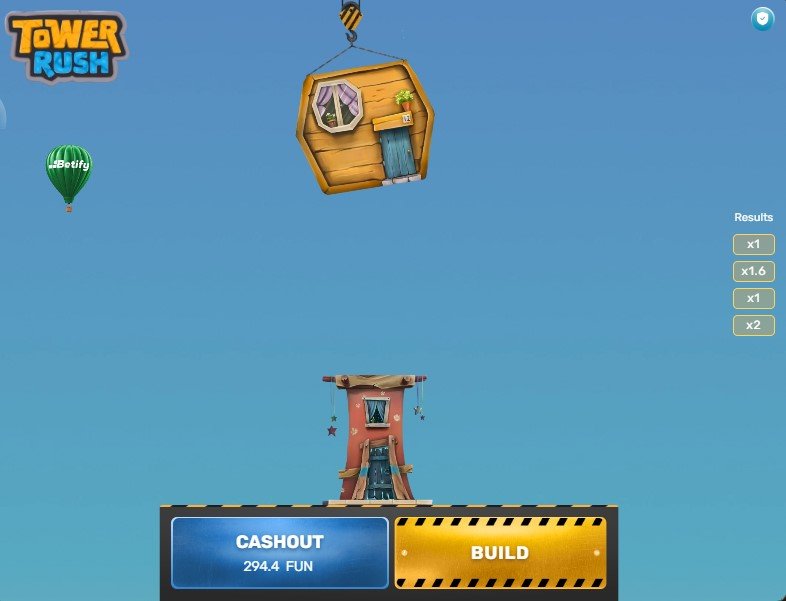
Practical consequence: the marginal return on investment of each additional floor evolves. Going from x2 to x4 (two floors in easy phase) requires little effort. Going from x10 to x15 (two floors in difficult phase) demands markedly higher precision and concentration. Marginal gain increases, but risk too.
Informed players identify their comfort zone. For some, it's x5. For others, x12. Beyond this zone, the additional gain / collapse risk ratio no longer justifies the effort. Finding this personal balance point is the work the demo allows.
A technical detail: block speed at floor 15 is about three times higher than at floor 3. The placement tolerance zone reduces proportionally. The player has less time to react, with a narrower error margin. It's the combination of both that makes phase 3 so selective.
Mistakes I Made (and Lessons Learned)
First mistake: increasing the bet after a series of shortened rounds. The compensation reflex is powerful, the logic behind it is false. Each round is independent of the previous. One round's result doesn't influence the next at all. Resisting this temptation is skill number one on Tower Rush.
Second mistake: delaying cashout "just one more floor." The classic, most costly temptation. That's exactly how you transform a secured x10 into x0. Exit discipline pays more than repeated boldness. If you decided x8 before launching, you cash out at x8.
Third mistake: playing tired. After 25-30 minutes, placement precision drops noticeably. The block falls slightly too early or too late. Rounds that were profitable become collapsing rounds. I learned to cut after 20 minutes maximum. Decision quality improves markedly after even a short break.
Fourth mistake: neglecting the demo. I started with real money directly, convinced the game was simple enough not to need training. Result: $15 lost understanding timing. A few free rounds would have sufficed to avoid it.
The Demo as Laboratory
Free mode isn't reserved for beginners. Players testing new approaches use it too. Modifying the cashout level, experimenting with progressive bet logic, observing interaction between bonuses and different risk levels. All that happens without wallet consequences.
Accessible without registration, unlimited virtual credits, gameplay identical to paid version down to details. A tool underestimated by players rushing to bet.
My personal test: 40 demo rounds with systematic cashout at x5. Result: 28 cashed games, 12 collapses before threshold. The ratio seemed viable to me. In real money, the same scheme produced a slight profit over two sessions. Not guaranteed long-term, but informed.
Cashout Psychology: Why It's So Hard
On paper, cashing out at x8 when you decided x8 seems trivial. In practice, the multiplier at x7.5 with a perfectly balancing block triggers an automatic thought: "one more, looks easy." It's precisely at this moment that discipline is tested.
Optimism bias plays fully on Tower Rush. After three consecutive successful placements, the player feels invincible. Confidence rises, cashout threshold recedes. And often it's the fourth or fifth additional floor that brings the tower down.
A technique that helps: formulate the threshold aloud before launching. "This round, I cash at x6." Verbal commitment adds a cognitive barrier against drift. Sounds dumb, but it works long-term.
The other psychological trap: premature round end pain. When the tower collapses at x3 while you aimed for x8, instinct pushes to relaunch immediately, bigger, to compensate. It's the shortest path to bankroll depletion. Taking 30 seconds between each lost round suffices to deactivate the reflex.
When to Move to Real Bets
The right moment arrives when you have a clear view of your play profile. After 30 to 50 demo rounds, you know at what multiplier you naturally cash out, how much you're willing to bet, and when you stop. At this stage, the transition to real money happens without surprises.
Account creation at a licensed casino, deposit via card or e-wallet ($10-15 suffices to start), and the game starts exactly like in demo. The difference is purely psychological. Gameplay doesn't change one bit.
For withdrawals: KYC verification at first withdrawal (ID, proof of address). Timeframes by payment method: e-wallets in a few hours, cards in 1-3 days, transfers in 2-5 days.
Mobile or Desktop: Where to Play?

Desktop with mouse: optimal precision. The click is instant, visual feedback sharp. The ideal environment to aim for high multipliers and play in comfortable conditions.
Mobile in HTML5: functional, well-designed, wide buttons. For 10-15 minute sessions on the go, it works. The game adapts in portrait and landscape.
The gap appears beyond the tenth floor. The finger on touchscreen introduces a micro-delay the mouse doesn't have. On placements requiring extreme precision, this detail can cost the round. Tested on iPhone 14 and Redmi Note 12, same finding: comfort until the eighth floor, then touch shows its limits.
Player Reviews
« Frozen Floor saved my session. I was at x14, the bonus activated, and I could try x22 without risking my winnings. »
« I spent three days in demo before betting. Best decision. My first withdrawal: $43 after a $15 deposit. »
« My strategy: cashout at x7, $1 bet. Eight rounds out of ten, it works. The other two, premature round end. »
« What I like is that each round requires a real decision. Not just pressing a button and waiting. You're an actor. »
« I use demo to test my approaches before betting. Personal rule: if it doesn't work in 20 free rounds, I don't do it with real money. »
Keeping a Cool Head
Tower Rush tires the brain faster than a classic slot. Required concentration is real, and fatigue pushes to hasty decisions if you don't impose breaks.
Define a fixed budget before each session. Use casino deposit limits. Never increase bets to compensate for shortened rounds. The casino's mathematical advantage remains constant, whatever the bet size.
A useful benchmark: after three consecutive round ends, take a break of at least 30 seconds. This dead time deactivates the compensation reflex and allows recalibration. After five, consider leaving the session. Not out of superstition, but for decisional hygiene.
RTP and Strategy: The Connection We Don't Always See
The 96-97% RTP is a mathematical constant. No strategy can modify it. On the other hand, how you play influences this RTP's distribution over time. A cautious player (low cashout, regular bet) will experience smoother sessions, with fewer peaks and valleys. An aggressive player will see rollercoasters: very positive sessions and other very negative ones.
RTP is the same in both cases. The difference is the journey's volatility. Choosing your cashout profile is also choosing your emotional profile. Players who poorly tolerate brutal drops will benefit from adopting a cautious style, even if unit wins are more modest.
A concrete way to visualize it: in 50 rounds at x3 cashout, you cash frequently but little. In 50 rounds at x20, you cash rarely but sometimes big. The theoretical redistributed total remains comparable, but the experience is radically different.
⚠️ National Problem Gambling Helpline: 1-800-522-4700 (free, confidential).
Practical Questions
Are bonuses available in demo?
Yes. The three bonuses work exactly like in real money mode, without restriction.
Can you set an auto-cashout?
No. Tower Rush works exclusively with manual cashout.
What bet to start with?
Between 1 and 3% of bankroll per round. With $50, this represents $0.50 to $1.50 per game.
Does the game require a download?
No. HTML5 allows playing directly in browser, mobile or desktop.
Does Tower Rush suit all profiles?
The game requires concentration and reactivity. It's aimed at players who prefer an active role to a passive experience.
Verdict
Tower Rush occupies a place apart in the current crash game offering. Bonuses bring a real strategic layer, manual cashout maintains engagement, and difficulty progression creates natural tension that few competing games achieve.
Mental fatigue, lack of automation, and high variance won't suit everyone. But for those seeking a crash game where every decision counts, Tower Rush delivers on its promises.
Final Rating: 4.2/5. Demanding and engaging, discover it in demo before betting.